Why the Most Modern Thing You Can Wear in 2026 Looks Like It Was Inherited
Share
Why the Most Modern Thing You Can Wear in 2026 Looks Like It Was Inherited
A Sunday morning in late spring, in an apartment on the second floor of a brownstone, the kind that has tall windows and slightly uneven floors and the particular northern light that makes everything in the room look like it has been there longer than it has. A woman is at her dresser with a cup of coffee, and she is choosing what to put on. She picks up a silver ring. She has been wearing the ring for six months, but it does not look like she has been wearing it for six months; it looks like she has been wearing it for ten years, like she has reached for it in this same room on hundreds of Sunday mornings, like the ring and the dresser and the morning have all been quietly making a record of each other while she was not paying attention.
This is a post about the most defining jewelry trend of 2026, and about why the most modern thing you can wear right now is the thing that looks like it has been inherited. It is also a post about Glass Balloon, and about why sterling silver is the material that earns this look honestly rather than performing it. The argument is not that the inherited piece is better than the new piece, though it sometimes is. The argument is that the new piece worth buying is the new piece that already knows how to be old.
The cultural signals have been arriving in sequence for the better part of two years. In August of 2025, when Taylor Swift announced her engagement to Travis Kelce, she did so wearing a ring that was, in the read of multiple jewelry historians who weighed in within hours of the announcement, a vintage-style piece that could pass for an heirloom: an old mine cut diamond, the antique cushion variant that was popular between roughly 1850 and 1920, hand-cut in proportions designed to sparkle under candlelight rather than under modern overhead lighting, set in an 18 karat yellow gold band with hand-carved detailing, designed by the New York jeweler Kindred Lubeck of Artifex Fine Jewelry.
In March of this year, at the 98th Academy Awards, Elle Fanning walked the red carpet wearing a Cartier necklace from 1903, a piece that predates the Art Deco movement entirely, originally configured as two brooches that doubled as a tiara, later reset as a necklace, comprised of round old cut diamonds in a millegrain setting on platinum. She wore it with a Givenchy gown by Sarah Burton that featured hand-embroidered wisteria. Per the Vogue interview that ran the following morning, Fanning had selected the necklace from the Cartier vault before Sarah Burton independently proposed the wisteria embroidery on the gown, which is to say the two women had both arrived at the same flower at the same time, from different rooms, without conferring.
The trade press read both moments correctly. Net-A-Porter, in their 2026 jewelry trend forecast, named Taylor's ring and Elle's Cartier as the two events that, taken together, brought heirloom jewelry back to the cultural foreground. Jack Weir & Sons, in their year-ahead piece, called the rise of the collector's mindset the most defining trend of the year, the slow and deliberate acquisition of fewer pieces chosen with sharper intention, the appreciation of pieces that arrive with their own histories or that are made in the manner of pieces that would have.
This is what people mean now when they say heirloom. They do not always mean a piece inherited from someone. They mean a piece that wears as if it had been.
What Is the Heirloom Jewelry Trend in 2026?
The heirloom trend of 2026 is the cultural preference for jewelry that looks as if it has already been loved. The piece may be antique, archival, or vintage in style. It may also be brand-new but designed in proportions and materials that develop character with wear rather than resisting it. The defining quality is patina rather than provenance, weight rather than newness, presence rather than performance.
The shape of the trend has been articulated in three places over the last year. The first is the auction floor, where the market for signed mid-century pieces from Cartier, Van Cleef and Arpels, and Tiffany has continued to climb in a way that the broader jewelry market has not, with collectors buying signed archival pieces because the signature now reads as documentation rather than as branding. The second is the red carpet, which through 2025 and into 2026 has seen a steady rotation of celebrities wearing pieces pulled from house archives rather than from current collections, and per the Hollywood Reporter's read of the 98th Academy Awards, the most significant jewelry of the night was, almost without exception, not new. The third is the customer-side conversation, the one that happens in private appointments and in Slack threads and on Instagram, where the woman who is buying jewelry for herself is increasingly asking the question of how the piece will look in ten years rather than how it looks today.
What links the three is the same underlying instinct, which is the instinct against catch and release. The woman who watches fashion in 2026 has, after several years of fast jewelry and influencer drops and the algorithmic disposability of pieces that all look like screenshots of other pieces, developed an appetite for something that arrives with weight, that does not depend on the season for its argument, that has the structural confidence of a piece that knows it will outlast the trend that brought it into the room.
Why Are Vintage and Antique-Style Pieces Having a Cultural Moment?
Because the woman who buys jewelry in 2026 is tired of jewelry that performs only in the moment. She is asking, increasingly, what a piece will look like in ten or fifteen years, who will inherit it, whether it will still feel like hers after a decade of being on her hand. The vintage and antique style answers that question by demonstrating, through objects that already exist, that pieces with these qualities are possible.
There is a longer reading underneath the trend reports that explains why all of this is happening at once. The cultural exhaustion with maximalism has converged with the financial exhaustion of buying fast jewelry that does not hold up, which has converged with the algorithmic exhaustion of looking at thousands of new pieces every week that all look like other pieces, which has converged with the deeper cultural longing for objects that have been somewhere and have witnessed something and have, in some quiet way, accumulated meaning rather than chased it. The antique cushion cut diamond on Taylor's hand was cut by candlelight. The Cartier wisteria around Elle's neck was made in Paris in 1903, in a workshop that has not existed for a hundred years, by craftsmen whose names have not survived but whose work has. These objects carry their making on them in a way that the contemporary market rarely sustains.
The Pursuit of Jade essay we ran last quarter was about the longer arc of this instinct, the way jade has been carrying meaning across cultures and across centuries because the material does the work of holding it. The heirloom moment in 2026 is the same instinct, arriving at a different material. The Net-A-Porter forecast from earlier this season put it as directly as a trade-press piece can put anything: heirloom jewels are trending once more, with Taylor Swift's vintage-inspired ring as the cultural event that returned the spotlight to ornate and decorative designs and with Elle Fanning's Cartier as the high-glamour confirmation.
Glass Balloon was watching this current before it was a trend. The brand was built around the same instinct that the heirloom moment is now articulating in trade terms: that the piece worth buying is the piece that arrives in your life and stays, that the morning ritual of putting it on becomes part of the day rather than separate from it, that the piece does not need to be inherited to feel inherited.
What Makes a New Piece Feel Inherited Rather Than Bought?
A new piece feels inherited when its proportions are deliberate, when its material rewards wear rather than punishing it, when its weight and finish suggest the piece was built to be on a body for a long time. The catch and release piece announces its newness on the first day. The inherited-feeling piece quietly refuses to.
The qualities are not difficult to describe, even if they are difficult to manufacture. A piece that feels inherited tends to have weight to it, the kind of weight that fits the finger or the wrist the way the wedding band of a grandmother fits the hand of the woman who has been wearing it for fifty years. A piece that feels inherited tends to have proportions that are slightly off from current trend, slightly more reserved or slightly more deliberate, in a way that makes the piece read as having an opinion rather than reflecting one. A piece that feels inherited tends to have a finish that is not perfect, that shows the small marks of having been worked by hand, that has the texture of a piece that someone actually made rather than the texture of a piece that was extruded into existence.
Most importantly, a piece that feels inherited has been built to age. The piece that announces its newness does so because it has been engineered to look new forever, in a material that does not change, with a finish that does not wear, and the eye reads this as a kind of permanent freshness that turns out to be the opposite of timelessness. The inherited piece, by contrast, has been built to develop into the wearer. It picks up a slight patina at the points of contact. It softens where the hand has held it most often. It collects the small evidence of being lived in, and the evidence is what gives the piece its weight.
Why Sterling Silver Becomes an Heirloom Material More Honestly Than Other Metals
Sterling silver patinas honestly. The material develops a soft warm tone at the points where it is most worn, a slight darkening in the recesses of any sculpted detail, a luminous quality at the high points where the wearer's fingers have polished it without intending to. Stainless steel cannot do this. Gold-plated metal cannot do this. The patina is the record of the wearing, and the patina is what turns a new piece into a piece that has lived with you.
This is a material argument and also an emotional one. Sterling silver, which is 92.5 percent silver and 7.5 percent copper, was the standard for fine jewelry for centuries because of how it ages. The piece is bright and reflective when it is new, and over months and years of being on the body, it develops what jewelers call a living patina, which is the gentle oxidation of the surface in response to skin and air and the small chemistries of being touched. The patina is not damage. The patina is the piece becoming specifically the wearer's. The same ring on two different women, after a year, will look slightly different from each other, because each ring will have softened to the habits of the hand that wears it, will have collected the small geographies of where each hand has been.
Stainless steel does not do this, and is engineered not to. Its appeal is the stability of its finish, the way it stays bright and unmarked through years of wear, and there is a real place for that finish in jewelry, and Glass Balloon makes pieces in stainless steel for the wearer who wants that quality. But the stainless steel piece, after a year, looks the same as it did on the first day. It has not become hers. It has only been worn by her, which is a different thing.
Gold-plated metal is the opposite of patina, because the plating wears off in spots, exposing the base metal underneath, which reads as failure rather than as character. The gold-plated piece does not develop. It only degrades. This is why gold-plating, despite being inexpensive to produce, has never been the material of heirlooms, and why the gold-plated bracelet in a grandmother's drawer, if she had one, has likely been thrown away by now while her sterling silver pieces have not.
Sterling silver, by contrast, becomes more itself with wear. The Starlit Band that you wear every day will, after a year, look like a Starlit Band that you have worn every day. After five years, it will look like the band of a woman who has had it for five years. After fifteen, it will look like the band of a woman who has reached for it on thousands of Sunday mornings without thinking, which is the kind of object that, when a daughter or a niece or a younger friend eventually finds it on the dresser, reads immediately as something that mattered to the woman who owned it.
This is the honest version of the heirloom argument. Not the simulated version, in which a piece is finished to look antique on the day it is made. The honest version, in which the piece becomes an heirloom by being worn long enough.
The Glass Balloon Pieces Designed to Be Inherited Forward
Three pieces, each designed in the material and the proportions that allow the piece to become specifically the wearer's over time.
For the daily piece that becomes the wearer's signature, the Sterling Silver Sculpted Ring, Starlit Band. The Starlit Band is sculpted in 925 sterling silver and built in proportions that sit low on the finger without snagging on a cuff or a sleeve, with surface contours that catch light unevenly across the band in a way that, over time and wear, develops the specific topography of the wearer's habits, brightest at the high points where her thumb most often passes across it and softer in the recesses where the silver collects the warm patina of skin contact. It is a piece that, by design, will look more itself after a year than it did on the first morning.
For the chain that is worn every day and seen most often by the wearer herself, the Silver Dainty Chain. The Silver Dainty Chain is the piece you reach for in the morning without thinking, the one that sits at the throat under the collar of a white shirt or visible at the open neck of a sweater, and what it shares with the eternity bands and the Cartier Tank watches that defined the heirloom register of an earlier generation is that it is the same piece every day, and that the wearing is what makes it specifically yours. Sterling silver chains in this weight develop the deepest patinas of any silver piece in a brand catalog, because they are in continuous contact with skin in the way that earrings and rings are not, and the chain quietly tells the story of being worn.
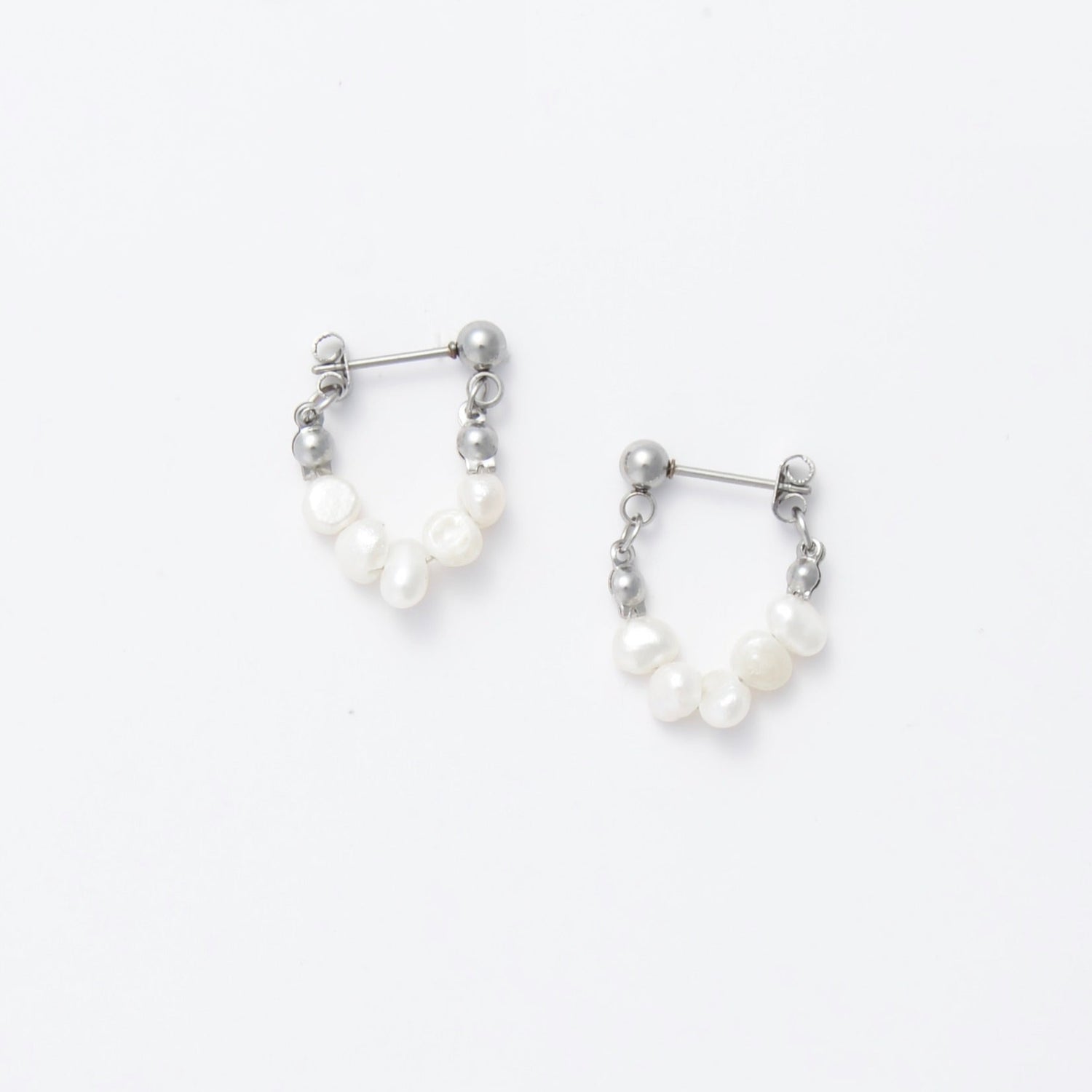
For the piece that has carried its own heirloom argument for several thousand years, a freshwater pearl from the pearl collection. The pearl is the original heirloom material, the substance that women have been passing to daughters for as long as women have been wearing jewelry, and the freshwater pearl in the Glass Balloon register is luminous and slightly irregular and has the small grain of imperfection that lets the wearer know the pearl was once alive. The pearl, like the silver, develops with wear, taking on the warmth and the slight burnish of having been in contact with skin. For the longer reading on this, see the pearl heirloom essay from earlier this month.
For the warm tone everyday counterpoint that operates in a different register entirely, the Everyday Gold Chain Necklace, Golden Thread. The Golden Thread is gold-plated stainless steel, designed to stay bright and tarnish-resistant for the woman who wants that finish, and it is part of the mixed metals conversation we covered last month rather than the heirloom one. The two registers coexist in the brand, and the wearer chooses between them. Some mornings she reaches for the piece that has been changing with her. Some mornings she reaches for the piece that stays the same.
For the full sterling silver register that holds the through-line of this argument, see the 925 Sterling Silver Collection. The collection is built around the material that earns the heirloom register honestly. Every piece in the room is designed to be worn for a long time, and to look like a piece that has been worn for a long time once it has been.
The Carolyn Bessette Kennedy Connection
The heirloom moment of 2026 is, at its quietest, a return to a worldview that was already articulated by Carolyn Bessette Kennedy in 1996. Her platinum eternity band, her gold wedding band cast from a rattlesnake's rib, her Cartier Tank watch and her pearl studs were not designed to look antique. They were designed to be worn every day for the rest of her life. The fact that they appear in retrospect to have been heirlooms is the effect of the wearing rather than of the design, the accumulation of the small evidence of being put on every morning for a decade, the slow process by which a piece worn long enough by the same woman becomes an extension of the woman herself.
This is the deeper reading that the trend reports do not quite arrive at. The piece that becomes an heirloom is the piece that has been worn long enough to become one. The piece that announces itself as an heirloom on the first day, that has been distressed and antiqued and finished to look as if it has been somewhere it has not been, is performing the look rather than earning it. The Glass Balloon argument, and the Carolyn argument before it, is that the better path is to start with the right materials and the right proportions, and to let the wearing do the work that the wearing is supposed to do.
For the full reading on Carolyn as Glass Balloon's spiritual ancestor, see the Carolyn Bessette Kennedy lineage essay from earlier this month, where the argument is made at length.
A Closing Note
A Sunday morning, ten years from now, in an apartment that may or may not be on the second floor of a brownstone, with light coming in through windows that may or may not be the same windows. A woman is at her dresser with a cup of coffee, and she is choosing what to put on. She picks up a silver ring that has the soft warm patina of having been worn every Sunday for ten years, that sits low on her finger the way it has always sat, that does not look new and does not need to. She puts it on, and she does not think about it. The ring has become the part of the morning she does not think about, which is the part of the morning that matters most.
Or, in the version that matters more to us, a woman opens a drawer in a different apartment and finds a ring her mother used to wear. The patina has the topography of her mother's hand. The piece has been somewhere. The piece carries the small evidence of the life it was part of.
This is what jewelry is for.