What Carolyn Bessette Kennedy Was Doing With Her Jewelry
Share
What Carolyn Bessette Kennedy Was Doing With Her Jewelry
September of 1996, on Greenwich Street in Tribeca, on a late summer afternoon that has the particular New York warmth of a day already turning toward evening. A woman walks south on her way to lunch, her hair down and her shoes flat, and on her left hand she is wearing one ring, the eternity band catching the light for a half-second before disappearing into the rest of her. Two photographers across the street, who have been waiting for someone else, lower their cameras as she passes them, having not realized until just now that the someone else was already walking by.
This is a post about Carolyn Bessette Kennedy and about what she was doing with her jewelry, but it is also a post about Glass Balloon and about the lineage we are claiming. Not the celebrity lineage, which is not ours to claim, but the aesthetic one, the discipline one, the lineage of a woman who in 1996 was already articulating the worldview that Glass Balloon was built around in 2024 and that the rest of fashion has spent the better part of 2026 trying to remember.
The arrival point is recent. In February of this year, FX premiered Love Story, the Ryan Murphy limited series about her marriage to John F. Kennedy Jr., a show that ran nine episodes through April and that did, in the manner of all Ryan Murphy projects, the work of returning a once-tabloid figure to the cultural foreground in a way that felt both inevitable and slightly belated. What followed was the kind of cultural surge that gets measured in numbers: a 9,100 percent increase in searches for Carolyn Bessette Kennedy in the month after the premiere, sixty-five million hours of streaming across Hulu and Disney+, the most-watched limited series in FX's history, twenty-one million posts on the hashtag, and a steady and seemingly unending current of TikToks, essays, retrospectives, and styling guides trying to articulate what the woman had been doing with her clothes.
What people were searching for, though, was not exactly Carolyn herself. They were searching for the shape of how she dressed, the column skirt and the white button-down with its cuffs left undone, the Manolo slingbacks, the single eternity band on her left hand, the pearl studs that came out for evening, and the discipline underneath all of it, which was the discipline of wearing one thing and trusting it.
This is the worldview Glass Balloon was built around, and these are the pieces she would have reached for.
What Did Carolyn Bessette Kennedy Wear for Jewelry?
She wore almost nothing, and what she wore could be written out in a few sparse lines. A platinum eternity band of alternating sapphires and diamonds, a simple gold wedding band cast from a rattlesnake's rib, a Cartier Tank watch that became her signature, occasional pearl studs, a thin gold ring worn not on her finger but on her toe, and almost nothing else.
What she wore could be written out in those lines, and even those lines told you everything. The platinum eternity band, given to her by John F. Kennedy Jr. when he proposed at Martha's Vineyard in July of 1995, was designed (per the Le Vian analysis of the piece) in a low comfort fit mounting that allowed it to sit close to the finger without snagging, modeled after Jackie Kennedy Onassis's so-called swimming ring. The simple gold wedding band was made by the artist Gogo Ferguson, who told Garden & Gun in a 2025 interview that the pair were cast from the rib of a rattlesnake. The Cartier Tank watch on her left wrist, per multiple biographical sources, was the one thing she put on every morning the way other women put on the day itself. The thin gold Cartier ring she wore on her toe was a piece she gave a matching version of to her friend Carole Radziwill during their last summer together, a small gesture of jewelry as relationship that almost no one knew about while she was alive.
What is striking about the photographic archive, in retrospect, is not what she chose but what she did not. In most of her appearances she did not wear a necklace, did not stack rings, did not own a chandelier earring that anyone has ever been able to identify; her ear was almost always bare or holding the pearl, her wrist held the Cartier Tank and the eternity band visible just above the cuff of a white shirt, and that was the inventory.
This was not an absence of jewelry. This was a discipline.
Why Did Carolyn Bessette Kennedy Wear So Little?
Because the discipline of minimalism is, counterintuitively, more difficult than the discipline of accumulation. A woman who wears one piece every day must trust that the piece is enough, and the trust is what is hard about it, not the absence. Carolyn trusted hers. The eternity band did not need a partner, and the Cartier Tank did not need a stack, and the pearl studs, when they came out for evening, were not asking the dress to do less work so that they could do more.
The accumulation impulse, the more-is-more impulse, is the impulse of the woman who does not quite trust that the one piece is doing what she needs the piece to do, and so she adds another, and another, and the body becomes loud in a way that announces a kind of anxiety the wearer may not have even known she was carrying. Carolyn did not have that anxiety, or if she did, she did not wear it on her hands. The pearl studs were part of the dress the way a punctuation mark is part of a sentence, and the work of the punctuation is to let the sentence land.
There is a quieter point underneath the discipline, which is that she was not asking her jewelry to tell anyone anything about her. She had already arrived. The pieces confirmed; they did not declare.
This is not, broadly speaking, how most jewelry brands talk to their customers. Most brands position the piece as the thing that is going to give the woman something: confidence, or identity, or a version of herself she has been waiting for, or the missing edge of her own self-presentation. Carolyn would have found this funny. The piece, for her, did not give her anything; the piece was what she reached for after she was already herself.
What Is the Carolyn Bessette Kennedy Aesthetic in 2026?
The aesthetic that has become the cultural mood of 2026, per Who What Wear's summer forecast, is the assemblage that defined Carolyn herself in 1996: a column skirt, often black and occasionally cream; a crisp white button-down with the cuffs left unbuttoned; Manolo Blahnik slingbacks in the Carolyne style, which were named after her; hair down and slightly damp, brushed straight; and one piece of jewelry, worn every day without thinking.
The shape of it matters more than the inventory, because the shape is restraint with intent. Each piece is doing the job it was put on the body to do, and the job is small. No piece is asked to perform for the camera; the camera arrives anyway, and the woman who is dressed this way has already understood that the camera will arrive whether she wants it to or not, and so the question of what she wears resolves itself into the smaller and more interesting question of what she actually likes. The fewer decisions are visible in the outfit, the more arrived the woman looks.
Glass Balloon was built around a version of this same woman, around the dark editorial register and the warm ivory and near-black palette and the named pieces that settle on the body and stay there. The brand had not, until now, said her name out loud. It is saying it now.
Why Carolyn Bessette Kennedy Is Glass Balloon's Spiritual Ancestor
The claim is not that Glass Balloon is making Carolyn's jewelry; we are not, and we never could, because her pieces were the specific products of a specific moment, a sapphire and diamond eternity band designed by a private jeweler with a Belperron lineage and a wedding band cast in gold from the rib of a rattlesnake by an artist living on a remote Georgia island. Her pieces had their own provenances. We have ours.
The claim is that the worldview is the same one.
A fitted statement piece, not an extravagant one. Carolyn's eternity band sat low on her finger in a comfort fit setting that was, per the Le Vian analysis, specifically designed not to snag, and what was striking about the piece in photographs was that you almost missed it the first time, and then on the second look it had the kind of quiet weight that you could not unsee. The piece had presence; the piece did not demand presence. This is the principle Glass Balloon is built around, the principle that the piece you wear today should be slightly distinctive and slightly its own thing, and should also fit your hand the way a ring you have worn for ten years fits your hand, and that the distinction between a piece that earns being looked at and a piece that demands to be looked at is the distinction that the brand was made for.
A reserved interior within the noise of the city. Carolyn's New York was Tribeca in the mid-90s, before Tribeca became Tribeca, and she lived there the way the people who moved to that neighborhood before it had a name lived there: she walked, she took the subway sometimes, she picked up her coffee at Bubby's, and the discipline of her personal style was inseparable from the city she was living quietly inside of. Glass Balloon's New York is the after-hours version of the same city, the version that holds the woman who is alone in her own kitchen at 8:14 in the morning and the woman who is walking back from a late dinner at 11 p.m. with one earring catching the streetlight, the city loud around her and the woman quiet inside it, the jewelry part of the quiet rather than part of the noise.
A wearer who has already arrived. The mistake that most lifestyle brands make is positioning the product as the thing that completes the woman, the missing piece that resolves her into a finished version of herself. Glass Balloon's position, like Carolyn's, is the opposite of that, which is to say the woman is already complete when she walks to the jewelry box, and the piece she selects is not the resolution of the sentence but the punctuation at its end.
A piece that rewards looking. This is where Glass Balloon and Carolyn most quietly agree. Her eternity band looked simple from across a room, and up close it was alternating sapphires and diamonds set in a low handmade platinum mounting, with the kind of craftsmanship that, per multiple jewelry historians, would now be classified as old money in its values, which is to say a piece that does not announce its expense but holds it in its proportions and its setting and its weight. The piece was not catch and release; it rewarded the second look, and the third. Every piece Glass Balloon makes is built around the same principle, that the first glance is restrained and the second glance reveals the work.
Florals as the soft grace note. This is the only place where Glass Balloon and Carolyn diverge slightly, because she did not arrange florals in her own frame, did not bring lilies onto a stone surface or place a pressed flower beside a chain. Glass Balloon does. The dark composition holds and the restraint holds, but a flower is in the frame somewhere, doing the small soft work of making the picture better than it had to be. If Carolyn were in the frame, the flower would be on the windowsill behind her, slightly out of focus, doing its job.
What Carolyn Bessette Kennedy Would Have Worn From Glass Balloon
Four pieces, each chosen as the modern translation of something she actually wore.
For the eternity band, the Sterling Silver Sculpted Ring, Starlit Band. The Starlit Band is not an eternity ring in design, but a sculpted band with a particular weight on the finger and a particular movement of light across its surface, and what it shares with Carolyn's ring is the underlying principle: a piece you wear every day, that sits low, that does not snag, that becomes the part of the hand you forget you are wearing until someone notices it and asks about it on the second look. It rewards being looked at. It does not ask to be.
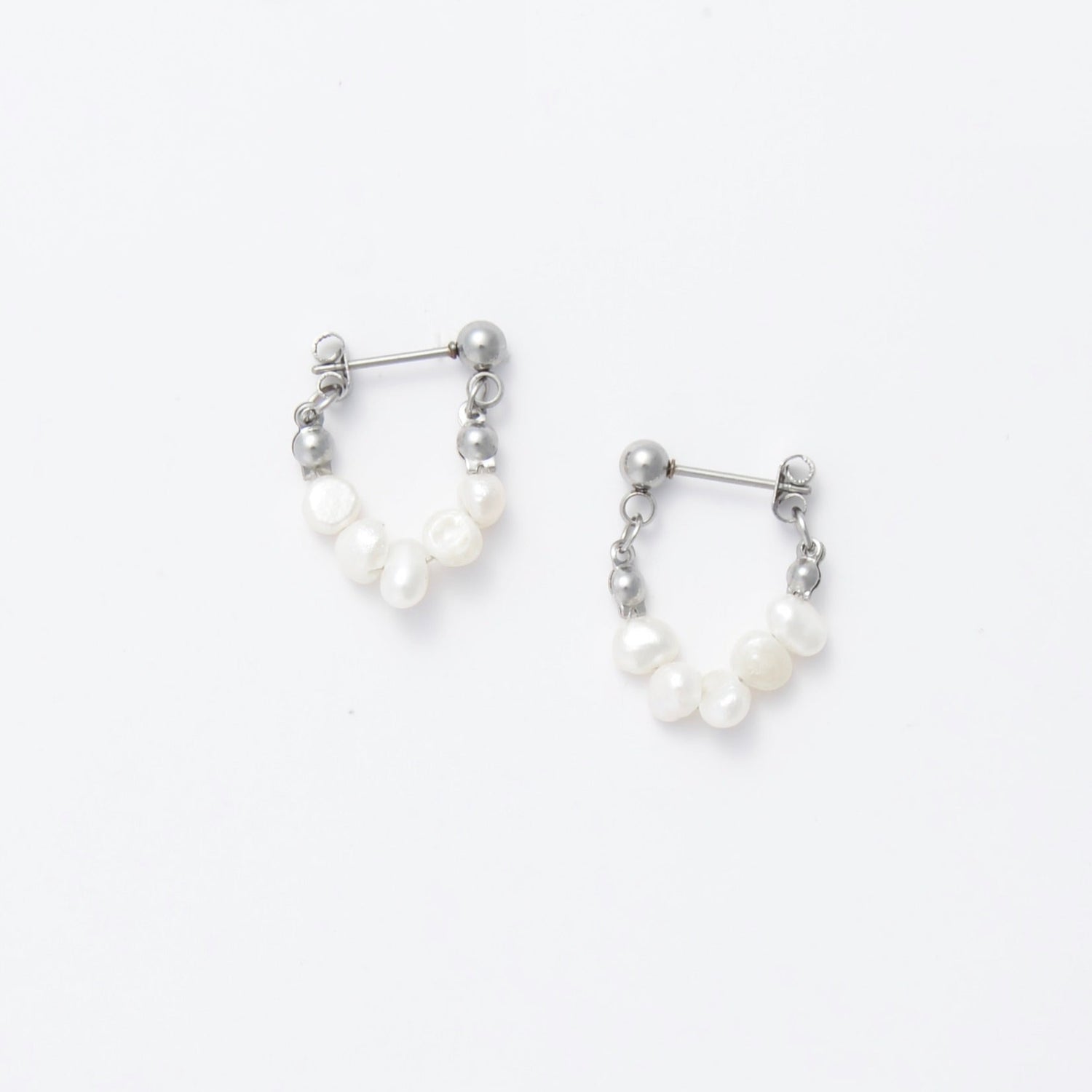
For the pearl stud, a piece from the pearl collection. Carolyn wore pearl studs occasionally and almost as an afterthought, as if she had reached into a small box on her dresser and pulled the first pair her hand found, and the Glass Balloon pearl works on the same logic, which is the logic of a real pearl rather than a perfect one: freshwater, slightly irregular, luminous in the particular way a freshwater pearl is luminous, with the small grain of imperfection that lets the wearer know the pearl was once alive. For the longer reading on why this kind of pearl becomes an heirloom, see the pearl heirloom essay.
For the Cartier Tank principle of one daily piece worn at the wrist or the throat, the Silver Dainty Chain. The Tank watch was the one item Carolyn put on every morning, and the Silver Dainty Chain is its analog: thin enough to disappear under a collar, substantial enough to read as deliberate when the collar is left open, the kind of chain that becomes the daily piece because it never asks for anything more than to be the daily piece.
For the warm tone that would have broken her cool palette in 2026, the Everyday Gold Chain Necklace, Golden Thread. Carolyn wore mostly cool tones throughout the 90s, silver and platinum and white, but a single gold piece would have made sense for her now, the way mixed metals make sense for the woman who is no longer asking permission, as covered in the recent post on mixed metals. Carolyn would have liked that retirement. She would have worn the Golden Thread under a white button-down where it would have appeared only at the open collar, a small warm punctuation in an otherwise cool sentence.
For the full sterling silver register that defines the brand and that defined the woman before the brand existed, see the 925 Sterling Silver Collection. This is the room Glass Balloon was built around, and Carolyn would have walked through it slowly.
Why 2026 Has Found Her Again
The cultural cycle is not random, and the Carolyn moment is not back by accident. It is back because the cultural exhaustion with maximalism is back, and the woman who watches fashion is looking, again, for a register that lets her wear less and feel more deliberate doing it. Per Who What Wear's summer 2026 forecast, the CBK aesthetic has become the season's defining mood, the column skirt and the white button-down and the single piece worn deliberately. Per Net-A-Porter, the heirloom moment is also back, with Elle Fanning's 1903 Cartier at the Oscars and Jisoo's 1905 Cartier at the Met Gala as the high-glamour bookends of a wider movement toward pieces that look as if they were inherited rather than bought. Per the Pantone announcement, the 2026 color of the year is Cloud Dancer, a muted warm white that is, almost exactly, the warm ivory of the Glass Balloon brand palette.
The reason all of this is happening at once is that the woman who wears jewelry in 2026 is tired of jewelry that performs. She wants jewelry that arrives with her, that has already been part of her morning before she walks out the door, that does the work of being beautiful quietly. The Pursuit of Jade conversation last quarter was about how jewelry can carry meaning across the centuries; the Met Gala conversation in May was about how jewelry can borrow history from the archive; the Cannes conversation right now is about how jewelry can hold its own at the scale of red carpet diamonds. The Carolyn conversation underneath all of those conversations is the quietest of them, and the most enduring, which is the conversation about how jewelry can disappear into the wearer and be more powerful for the disappearance.
This is Glass Balloon's argument, and it is also hers. We are claiming the lineage out loud now.
A Closing Note
September of 1996. The woman walks south on Greenwich Street, and the sapphires on her left hand catch the late summer light for the half-second it takes for the photographers across the street to realize that the someone else they were waiting for is already walking past them. She turns left at the corner on her way to lunch, wearing one ring, having decided thirty years before anyone else that this would be enough.
May of 2026. A woman walks south on Greenwich Street, and Tribeca is not what it was, but the light at this hour of the afternoon is still the light it was then. She is wearing one ring, though not a sapphire. It is a Starlit Band, sterling silver and sculpted, sitting low on her left hand the way Carolyn's eternity band sat low on hers, and she is on her way to lunch, and the photographers, if there were any, would not notice her either.
The discipline holds.