Why the Pearl Becomes the Heirloom
Share
She is at the dinner table on a Tuesday in 2026, and she is wearing the pearls her mother gave her in 1992. The pearls have warmed in color in a way they were not at the start, the individual pearls slightly softened, and the gold clasp has lost its original brightness. Nobody at the table notices the pearls. She is not wearing them to be noticed. She is wearing them because she has worn them for thirty-four years, which means they go with everything she owns, including the cardigan she put on this morning without thinking. After dinner, in the hallway, her granddaughter will reach up and touch them and ask, in the tone children use for the small old objects of older women, what those are.
This is a post about why the pearl, more than any other piece of jewelry, becomes the heirloom. The short answer is that pearls are the only living material in jewelry, the only piece that records the wearer's body over time, and the only piece priced low enough that the giving is about meaning rather than money. Five mechanics drive this: the material itself, the way pearls absorb the wearer, the care they require, their economic position relative to diamonds and gold, and the way they refuse to go out of style. What follows is each of those, in sequence, with the Glass Balloon pearl guide as the longer reference and 925 sterling silver as the supporting metal across most of the catalog.
Pearls are the only living material in jewelry
A pearl is the only object in jewelry that was once part of a living body. Diamonds are crystalline minerals formed under geological pressure, gold is a metal pulled out of the ground, and even gemstones such as emeralds, sapphires, and rubies are minerals formed by geological processes. Pearls are different. Pearls are made by an animal, specifically by a mollusk, in response to an irritation that the animal's body cannot expel. The pearl is what the body lays around the irritation, layer by layer, over years.
This matters for inheritance because organic materials carry meaning that mineral materials do not. The pearl is born from a body's response to suffering. It is the only piece of jewelry whose origin story matches the metaphor of motherhood, which is part of why the recent post on becoming your mother ends with a pearl rather than with anything else. A daughter who receives her mother's pearls is receiving an object that was once a living body's quiet effort to cope with what it could not remove. There is no version of the diamond that does that work.
The freshwater pearl, in particular, is the variety most associated with the inheritance gesture. Freshwater pearls grow in rivers and lakes rather than in saltwater oysters. They are slightly less round than their saltwater cousins, slightly more individual in their shape, and form more quickly, usually two to seven years per pearl. The slight irregularity is part of what makes them feel earned rather than manufactured. Each pearl is a record of a specific body's specific response to a specific irritant, in a specific window of time.
Pearls record the wearer's body
Unlike diamonds or gold, which look the same after a hundred years as they did on day one, pearls change with wearing. They develop a patina from skin oils. They soften slightly. They take on the body chemistry of the woman who wears them. A pearl piece worn for thirty years is literally a different object than the pearl that was first strung.
The mechanism is chemical. The wearer's skin produces oils, which the pearl absorbs. Over decades, the absorbed oils give the pearl its patina, which is the warm tint that distinguishes a worn pearl from a new one. The patina is the wearer. It is not damage and not aging in the negative sense, but the pearl recording who has worn it.
This matters for inheritance because the daughter who receives her mother's pearls is not receiving the pearls as they originally were. She is receiving the pearls as her mother shaped them: through three decades of skin contact, through afternoons in summer light, through the small daily friction of being worn against the same neck for ten thousand days. The pearls are her mother in a way no other piece of jewelry can be. A diamond ring worn for thirty years looks the same as a diamond ring worn for one day. The pearl strand worn for thirty years has been changed by the woman who wore it, which means inheriting the pearls is inheriting some part of the woman herself.
This is the second mechanic that distinguishes pearls from other heirloom jewelry. The first was the material origin, organic rather than mineral, and the second is the wearing record, which only pearls keep. That record is what makes the inheritance feel personal rather than ceremonial.
Pearls require care that teaches care
Pearls are 2.5 to 4.5 on the Mohs hardness scale, which means they scratch easily. They absorb perfume, lotion, and hair products. They need to be cleaned with a damp cloth rather than a polishing cloth, stored separately from harder jewelry, and restrung every few years if they are on a string. The act of caring for a pearl piece is itself a small daily ritual.
This care matters for inheritance because the next generation learns the ritual by watching. A daughter who watches her mother put on her pearls last (after lotion and perfume have dried) and take them off first (before bed) learns a vocabulary of careful handling without being taught. The pearls become the curriculum. By the time the pearls move down to the next generation, the next generation already knows how to wear them, because she watched her mother wear them for twenty-five years.
This is also why pearls last across generations when other jewelry does not. Diamonds and gold do not require active care to survive. They can sit in a drawer for fifty years and emerge unchanged. Pearls cannot. A pearl strand left in a drawer for twenty years dries out, the silk strand decays, and the pearls themselves can crack. Pearls have to be worn or they die. Which means the inheritance comes with an obligation, and obligations are how heirlooms stay alive.
For the longer reading on the care of silver and pearls together, the jewelry care guide covers the daily and seasonal practice in more depth. The short version: pearls are last on, first off, never in water, never with chemical cleaners, restrung when the gaps between pearls start to widen.
Pearls are not the family's biggest financial asset
Freshwater pearls have always been priced lower than diamonds, gold, or other categories of heirloom jewelry. A Glass Balloon freshwater pearl piece in 925 sterling silver costs thirty to eighty dollars. A Tiffany freshwater pearl strand costs several hundred to several thousand. A natural saltwater pearl strand from Mikimoto runs into the tens of thousands. The freshwater pearl in particular is priced for the everyday inheritance, the piece that gets worn and passed down rather than locked in a safe.
This matters for inheritance because the giving is uncomplicated. When a piece is the family's biggest financial asset, giving it carries a financial weight that contaminates the gesture. Diamond rings get appraised, insured, photographed for documentation, and occasionally fought over in estates. Pearls are passed without paperwork. The mother's freshwater pearl strand at four hundred dollars becomes the daughter's freshwater pearl strand. There is no estate tax conversation. The piece moves the way memory moves, between bodies, without legal friction.
The economic position of pearls is part of why they survive across generations. Heirlooms that are also financial assets get sold during financial difficulty. Heirlooms that are not assets stay in the family because there is no incentive to sell them. The freshwater pearl strand survives the recession because nobody bothers to liquidate it. The diamond ring does not always survive.
This is a quiet argument for the freshwater pearl over the cultured saltwater pearl as the inheritance gift. The freshwater pearl is the variety priced for the long story rather than the singular event. A piece given at fifty dollars is a piece that will be worn for forty years rather than locked in a safe. The economics of the pearl encourage the wearing, which is what makes the inheritance work in the first place.
Pearls do not go out of style
Pearls have been worn continuously for at least four thousand years, across nearly every culture that has had jewelry. They have been worn by queens, by drag performers, by First Ladies, by writers, by farmers' wives, by prime ministers and by their wives. They do not move in and out of fashion the way other pieces do. A pearl piece given in 1955 still reads correctly in 2026.
The reason pearls outlast fashion is that pearls do not have a period attached to them. The Art Deco diamond brooch reads as the 1920s. The gold link bracelet reads as the 1980s, and the cocktail ring reads as the 1950s. The pearl strand reads as no decade in particular, which means it reads as the wearer's decade. The pearl that the grandmother wore in 1957 looks the same in 2026 because pearls have been doing this work, in roughly the same form, for centuries.
Coco Chanel popularized the long pearl rope worn casually with daytime clothes in the 1920s, which decoupled pearls from formal occasions and made them part of everyday wardrobes. From there, pearls have been showing up across every fashion era, on women who needed the piece to do different work in different decades. Jackie Kennedy's triple strand in the early 1960s read as American First Lady. The pearl strand worn over a flannel in the early 1990s grunge era read as the rebellion against itself. The pearl resurgence in 2024 and 2025, picked up across the SS26 runways with sculptural pearl earrings and reimagined chokers, reads as quiet luxury. Each era's pearl reads differently, but the pearl itself reads as itself.
This is the fifth mechanic for inheritance: the piece does not date. A pearl piece given in any year, in any culture, will not need to be updated to be wearable thirty years later. The granddaughter who inherits the pearls in 2050 will wear them with whatever she is wearing in 2050. They will fit. They have always fit.
The giving ritual versus the wearing ritual
There are two rituals attached to inheritance jewelry, and pearls do both better than any other piece. The giving ritual is the moment the piece changes hands, often at a milestone like a wedding, a graduation, a birth, or the death of the woman who held it before. The wearing ritual is what the receiving woman does with the piece for the next thirty years. The two rituals are usually separated by decades, and almost everyone overestimates the importance of the first one and underestimates the importance of the second.
The giving ritual gets photographed. There is a moment in many family albums where the pearls are around the daughter's neck for the first time, with the mother behind her, often in front of a mirror, often slightly emotional. That photograph becomes the artifact of the inheritance. It is the version of the inheritance that gets remembered.
But the giving ritual takes about ten minutes. The wearing ritual takes thirty years. The thirty years are the actual inheritance. They are the daughter putting the pearls on every morning without thinking, taking them off every night without thinking, having the pearls restrung at year fifteen, replacing the silk thread at year twenty-two, switching the clasp at year twenty-eight. The pearls become her in a way that no single moment can produce. The wearing is where the piece becomes hers.
The reason this matters for what to give is that the gift that becomes a real heirloom is not measured by how impressive the giving moment is, but by how completely the piece can be absorbed into the receiver's daily life. A diamond ring that sits in a safe is not an heirloom. A pearl strand worn every day for forty years is.
What to start with
To start an heirloom chain in pearls, the simplest beginning is a freshwater pearl piece in 925 sterling silver, given on a milestone the receiver will remember. A bracelet, a strand, a small pearl pendant, a pearl ring. The receiver should be at an age where she will wear it for at least thirty years. A pearl piece given to a daughter at twenty-three is the start of the chain. A pearl piece given to a mother at sixty-eight is a different kind of gift, no less meaningful, but a different mechanic.
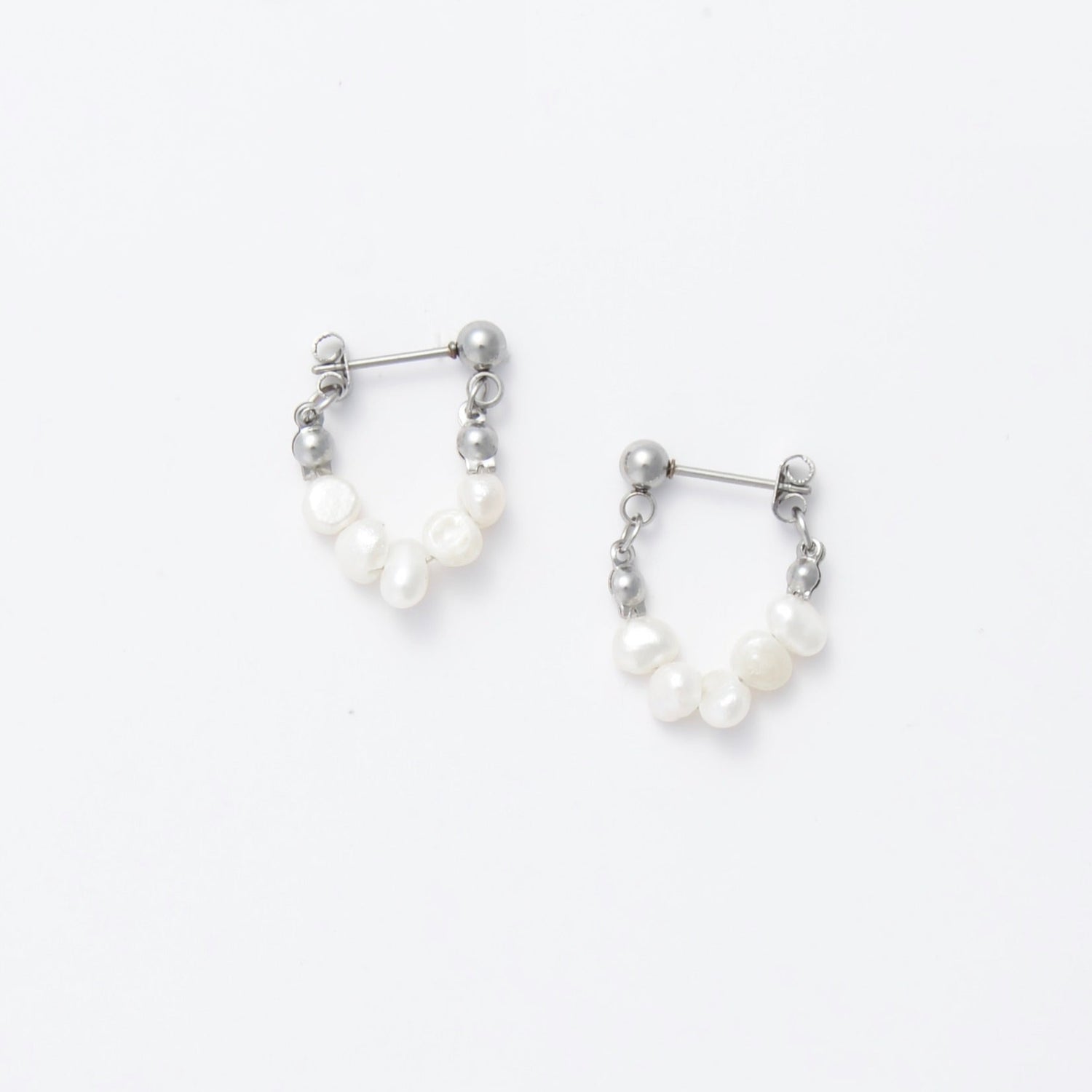
The Glass Balloon catalog has freshwater pearl pieces across categories. The pearl beaded necklace in 925 sterling silver, in the choker length or the strand length, is the most direct heirloom starter. The pearl bracelet is the same gesture for a wrist that already wears something else. The pearl ring is the rarer choice, suited to a finger that will not change size for decades, which is to say a finger that has settled.
The piece given is less important than the chain it starts. The first pearl strand is followed by the first pearl earrings at the next milestone, the first pearl ring at the milestone after that. The collection accumulates the way the wearing does, slowly, by addition. Forty years on, when the receiver is sixty-three and her own daughter is twenty-three, the collection is what gets passed down, not just the original piece. The chain is the actual inheritance.
What stays
Back to the dinner table, on a Tuesday, in 2026. The granddaughter has reached up and touched the pearls. She has asked, in the tone children use for the small old objects of older women, what those are. The grandmother takes the pearls off and puts them around the granddaughter's neck for one minute, just to see how they will look in twenty years. She takes them back and puts them around her own neck again. The granddaughter goes back to her dinner, the pearls go back to the cardigan, and the thirty-four years continue.
Some morning, in some year, the pearls will be around the granddaughter's neck for good. The grandmother will be the one giving them, or she will not be there to give them. Either way, the chain will continue, because pearls are the only piece of jewelry that knows how to wait.
Tags: glass balloon, pearl jewelry, freshwater pearls, heirloom jewelry, pearl meaning, sterling silver