What Pursuit of Jade Quietly Taught Us About Silver Layered Necklaces
Share
What Pursuit of Jade Quietly Taught Us About Silver Layered Necklaces
She presses pause halfway through episode four. Fan Chang Yu has just finished butchering a hog with a knife the length of her forearm. The shot lingers on her hands. The shot lingers, also, on the simple silver chain at her throat that has been there for every scene since the first one. The chain is plain, and the chain is not the point. Or rather: the chain is, completely, the point.
Pursuit of Jade is the C-drama that crossed over to Western audiences in March 2026, and the conversation around it has so far been about the costumes, the cultural appropriation controversy, the fight scenes, the fact that its lead actress can carry a six-foot-three man on her back without breaking stride. What the conversation has not yet caught up to is the styling philosophy underneath all of it. The clothing is not extravagant on close inspection. The looks read as plain at distance. The complexity is in the layering, in the textures, in the small ornament work, in what gets added one piece at a time. This is the way Glass Balloon has always thought about jewelry. The show is the cultural moment that gave the philosophy a name.
The post that follows is a reading of the show through seven characters, with both a necklace and a ring from the 925 sterling silver collection paired to each. It is also a reading of the SS26 fashion season through the show. And it is a defense of the silver layered necklace as the most quietly intelligent thing you can put on right now.
What the show is, and why the styling is the actual story
By March 15, 2026, Pursuit of Jade had landed at number six on Netflix's Global Top 10 for Non-English TV, with 1.9 million views and 34.2 million hours watched in a single week. Per Weibo TV Series, it became the first mainland Chinese drama to land a spot on Netflix's weekly chart. The show is now in the top ten in nine Asian regions, with sustained presence in the United States. This is no longer niche.
The story itself is straightforward. Fan Chang Yu, played by Tian Xiwei, is a butcher's daughter who enters a marriage of convenience with a fallen marquis named Xie Zheng, played by Zhang Linghe. He is hiding his identity to investigate his family's massacre. She is trying to keep her family business alive. Their fake marriage becomes real love. War tears them apart. She picks up a butcher's knife and goes to find him. The plot is genre. The execution is something else.
Director Zeng Qing Jie put it most clearly in an interview after the premiere. The show, he said, "does not pursue strict archaeological reconstruction but rather a xieyi-style Eastern aesthetic expression." Xieyi is a Chinese term that means, roughly, capturing the spirit rather than the literal form. It is the difference between drawing a horse hair by hair and drawing a horse so the viewer feels the speed of it. The same logic governs the costuming. Each character's clothes are not historically pristine. They are emotionally pristine. Every layer has a reason. The pheasant plume that Xie Zheng wears in his headpiece, for example, is described by the director as "the spine that refuses to bow in turbulent times." It is a feather, structurally. It is the entire personality of the character, narratively.
This is the part most styling guides miss. Layering, done well, is not addition. It is composition. Every piece on the body is doing a job, and the jobs add up to a sentence the viewer reads in one glance.
The SS26 fashion season has been arguing the same thing
Spring 2026's runway collections, read in full, made the same case. Marie Claire's spring jewelry coverage opened with a thesis that could have been written about the show: personality is the most valuable currency in fashion right now, and the dainty quiet-luxury chain that has dominated since 2021 is no longer enough. The collections that backed this up were not subtle. Chanel showed coral chokers. Tory Burch hung sundial shells from gold chains. Brandon Maxwell, Givenchy, and Ferragamo all sent sculptural earrings down their runways.
What this means for silver, specifically, is a moment of opportunity. Per Who What Wear's spring 2026 jewelry coverage, with the price of gold rising, silver is moving to the forefront in 2026 in chunkier, doubled and trebled forms. Silver is the metal having a season. And the silver layered necklace, which has been a category for years, suddenly reads as exactly the kind of personality-forward piece SS26 is asking for.
The bridge between the runway and the C-drama is the shared rejection of dainty for dainty's sake. Both want layers. Both want texture. Both want every piece to mean something. Browse the layered necklaces collection with this in mind and the pieces look different than they did six months ago.
Seven characters, seven reads on what jewelry can do
What follows is the kind of analysis that would normally be a personality quiz. It is not a quiz here. The characters are too well drawn, the styling too considered, to be reduced to that. Each character below comes with both a necklace and a ring, paired to match their visual presentation on screen and the symbolic weight they carry in the story.
Fan Chang Yu, and the working hands
The female lead is a butcher's daughter who becomes a general. She carries a butcher's knife into battle and uses it. She is, per the show's own promotional material, feisty and resilient with superhuman strength. She also, as one MyDramaList reviewer noted, starts off as a simple, straightforward, kind but somewhat ditzy girl. The character contains both states. She is rooted and she becomes formidable. The visual shorthand for her is consistency: the same simple silver pieces are with her in the village and on the battlefield. Her hands are working hands.
The necklace match is the Twisted Paperclip Chain Choker, Direction Set. It is structural and not decorative. It does not announce itself. It sits at the throat with the same weight whether the wearer is making coffee in the morning or walking into a meeting where she is the youngest person in the room. The name is the giveaway. It is a piece for the woman who has decided which way she is going.
The ring match is the Cuban Chain Ring, Link by Link. The chain logic is literal: a butcher's daughter understands chains, the way meat hangs, the way weight distributes. The ring reads as architectural rather than decorative. It is the kind of piece you can wash dishes in and not think about. That is the highest possible compliment for a working woman's jewelry.
Xie Zheng, and the coded surface
The male lead is, on the surface, a frail and sickly scholar. In reality he is the Marquis of Wu'an, a military commander hiding his identity to investigate a seventeen-year-old blood feud. The show's central visual motif for him is the pheasant plume in his headpiece, which the director called the spine that refuses to bow. Everything about the character is hidden meaning. The robes that look plain are concealing a sword. The scholar who looks frail is the strongest fighter in the room. As one fan reviewer put it, his arc is internal. He spends the entire series learning vulnerability with the only person who has ever protected him.
The necklace match is the Silver Bar Link Necklace. The architectural bar reads as clean and contained at first glance, the way a scholar would read. Closer in, the construction is heavier than it looks, and the connection point between bars carries weight. This is exactly the visual logic of the character. Plain on the outside, structurally serious underneath.
The ring match is the Roman Numeral Silver Ring, the Timekeeper. The numerals look architectural at a glance. They are also, if you read them, telling you something specific. It is a piece you wear on a finger that someone might glance at across a table and not understand at first. Then they look again. The most intelligent jewelry usually rewards a second look, and Xie Zheng is the most intelligent character in the room he is in.
Yu Qian Qian, and the modern fresh build
Chang Yu's best friend runs Yixiang Restaurant in town. She is a businesswoman before she is anything else. She has a hidden child by Qi Min, a fact she carries quietly. Her relationship with Chang Yu is the platonic love story underneath the romantic one, and one of the strongest emotional bonds in the show. The visual presentation is the cleanest of the women in the cast: she dresses for work, she moves with practiced efficiency, she wears the same things often and well. She is the modern character in period clothing. The piece you would put her in if she walked off the screen and into a brunch in Soho would read as fresh, clean, contemporary.
The necklace match is the Layered Paperclip Chain. The paperclip silhouette is the most modern chain motif in jewelry right now, the link shape that reads as 2026 rather than as anything historical. Layered, it sits with intentional asymmetry. It is the chain a woman wears because she likes how it looks and not because it means anything to anyone else. That is Yu Qian Qian.
The ring match is the Intertwined Silver Ring, Subtle Pull. The intertwined construction is contemporary in a way most rings are not. The pull is in the name. She is a woman who has decided what she wants and is steadily moving toward it, including escape from a man who claims to love her. The ring is small and not precious. It is the kind of thing she would wear seven days a week and not lose track of.
Fan Chang Ning, and the teddy bear charm
Chang Yu's baby sister is the soft center of the household. She is the reason the older sister works as hard as she does. She is the gentle one, the protected one, the one whose room has the small comforts in it. The visual shorthand is delicacy. Her costume choices in the show favor lighter colors, simpler shapes, the kind of styling that reads as girlhood without being childish.
The necklace match is the Silver Bar Link Necklace with Teddy Bear, the Mischief. The teddy bear charm is the only piece in the catalog that holds this kind of soft sweetness without sliding into preciousness. It is a piece you would buy for a younger sister, or wear because you are someone's younger sister, or wear because the part of you that is still soft is the part you most want to keep. Per the brand's own Bear character series, the teddy bear is not a children's motif at Glass Balloon. It is the symbol of after-hours softness in a city that asks women to be hard.
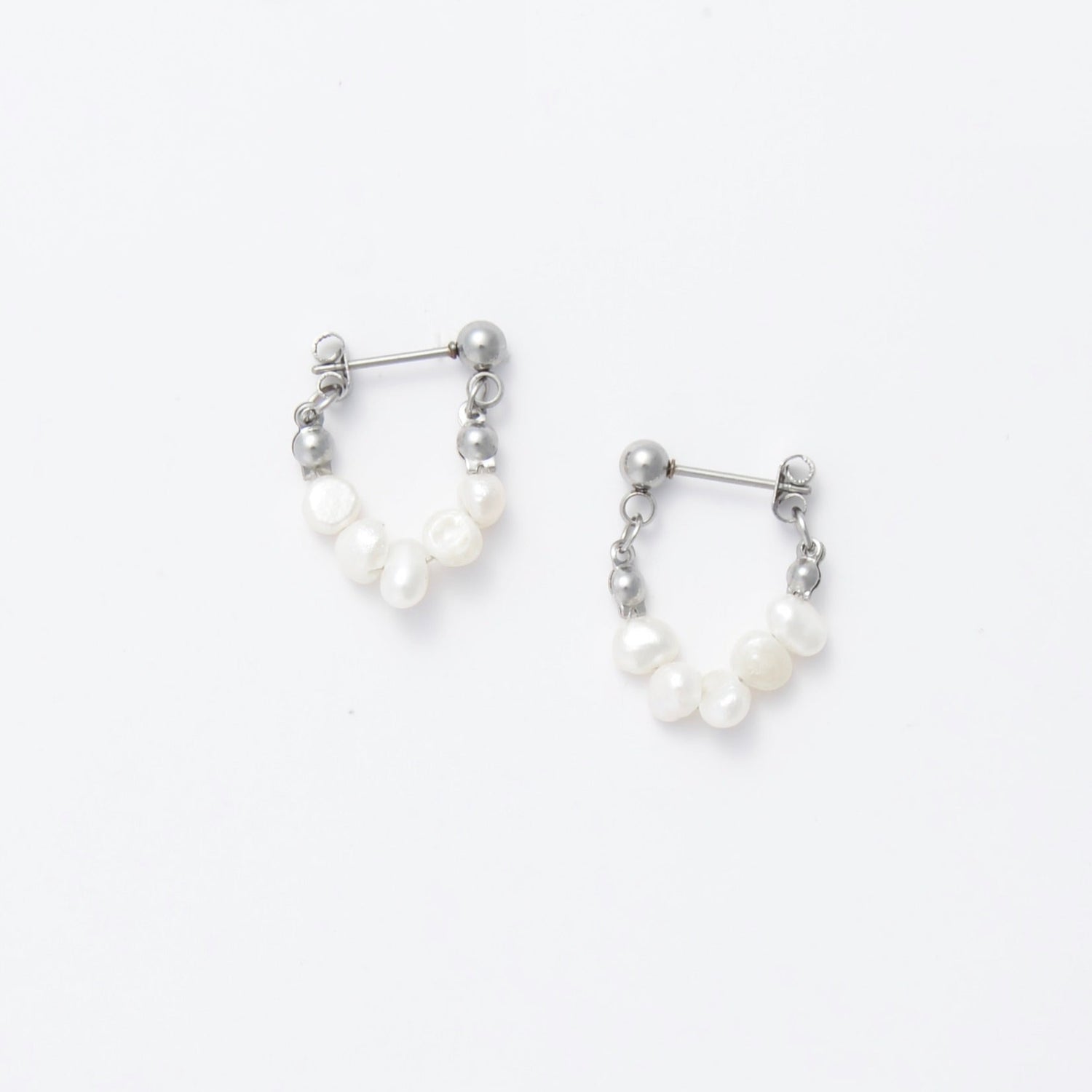
The ring match is a pearl ring. A single freshwater pearl on a delicate band is the visual equivalent of Chang Ning herself: small, irregular in the way nature is irregular, luminous against skin. It is the ring an older sister would buy for a younger sister at a milestone. It is also the ring that woman would still be wearing twenty years later, which is the right length of time for sisterhood to last.
Qi Shu, and the pearly layered build
The princess Qi Shu is the show's most quietly radical character. She is an emperor's sibling who does not get along with him. She is engaged to a man she does not love because of family politics. She is in love with a common-born scholar she is forbidden to marry. Her interior life is in constant friction with her public role. Visually, she is one of the most styled characters in the show: her hair is elaborate, her robes are layered, her ornaments are formal. The aesthetic is royal pearl. Soft and undeniable. Beautiful in the precise sense of the word: a beauty that is making a point.
The necklace match is the Layered Chain and Pearl Pendant Necklace Set, Visual Rhythm. This is currently the most-bought necklace at Glass Balloon, and the reasons are also the reasons it fits Qi Shu. The set layers a delicate chain over a pearl pendant strand. It reads as one piece at a glance and reveals itself as several. The "Visual Rhythm" name is the cadence of court music, of poetry recited at a banquet, of the way a princess moves through a room with three layers of sleeve and the eye not quite knowing where to land. Browse the pearl beaded necklaces collection and read the pieces with her in mind.
The ring match is a single pearl ring from the pearl rings collection. A pearl on the right finger is a quiet declaration. It says the wearer has chosen something soft on purpose, in a world that thinks softness is weakness. Qi Shu's whole arc is the discovery that the things she wants are valid even when she cannot have them. The ring is the small refusal she gets to wear in public.
Qi Min, and the heavier silver
Qi Min is the show's most psychologically complicated character. He is a high-ranking court official, the son of the late Crown Prince Chengde, raised as a replacement child after his face was severely burned in the same fire that killed his real mother. He is the strategic mastermind antagonist of the show. He is also, per the costume historian commentary on Newhanfu, the character whose inner life the director gave the most visual weight: the dark robes, the hidden scarring, the formal court ornament. He carries a wound the show takes seriously.
His relationship to Yu Qianqian is the show's most quoted subplot. She saved him from drowning when she did not know who he was. She did not flinch at his face. She did not flinch at his power. He spent the rest of the show trying to absorb the freedom she has and that he was never allowed. In his final moments, he tells her he envies her. This is not a villain. This is a man who was never given the chance to be anything else.
The necklace match is the Silver Curb Chain at twenty inches. The curb chain is the heaviest visual silver in the catalog. It sits low on the chest and carries actual weight. It is the chain a person wears when they want the body to register the presence of metal at every step. It is also a chain that reads as architectural rather than decorative, which is how Qi Min experiences his own presence in a room.
The ring match is the Sterling Silver Statement Ring, Bold Contour. The sculptural construction takes up real space on the hand. It is the ring of a man who plays chess with people. It is also the ring of a man who is intelligent enough to know that he is doing it, and grieved enough to wish he could stop. This is the dual reading the show insists on for him, and the piece holds both.
Gongsun Yin, and the quiet current
Gongsun Yin is the show's quiet revelation. He is the headmaster of Luyuan Academy and Xie Zheng's military strategist. He is also the man Princess Qi Shu falls in love with through a single chess game played in a temple pavilion, neither knowing the other's identity. Their love story is the most restrained romance in the drama, built on stolen glances, deliberate distance, and a profound respect for the boundaries of their time. He is common-born. His family has not held official office in a hundred years. He knows from the moment he realizes who she is that he cannot have her, and he loves her anyway, in silence, for years.
The visual signature is unmistakable. The first time Qi Shu sees him at the academy, his white robe is "coated with a layer of pale golden sunlight." His voice, described in the source novel, is "a spring afternoon breeze passing through a courtyard, warm yet elusive." His feelings are buried "within the squares of the chessboard, transforming longing into strategy." When she is finally in mortal danger, he abandons every restraint he has held for a decade and saves her life publicly, trading his future for hers. They eventually walk away from the court together. Her betrothal gift to him is not jewels. It is his family's library.
The necklace match is the Minimalist Rope Chain Necklace, Quiet Current. The name does the work the character requires. Quiet current is exactly what he is: depth that moves without disturbing the surface. The minimalist construction matches his restraint. The warm undertone of the chain matches the golden sunlight always on his robe. It is a piece for the woman who has chosen intellectual integrity over status, who values depth over display, who is drawn to quietness with hidden warmth. There is no louder accessory she could wear that would say more about her.
The ring match is the Sterling Silver Sculpted Ring, Starlit Band. The sculpted construction reads as deliberate rather than decorative. The starlit name carries two readings at once: his celestial chess mind that sees every move ten steps ahead, and the small private light he keeps under composure for the woman he refuses to allow himself to want. The ring is the visible version of an invisible discipline.
Now: how to actually layer like the show
The character readings are the editorial. This part is the actual styling lesson, because the post would be incomplete without it.
The show's layering convention is not three-chains-and-done. It is a base, plus an architectural piece, plus a quiet piece that closes the look. The base might be the simplest thing in the wardrobe. The architectural piece carries the weight. The quiet piece, often the smallest, is what the eye returns to. This is the same logic Glass Balloon has been working with in the necklace layering guide, now with a name.
For everyday wear, the Glass Balloon translation is the Silver Dainty Chain at the longest length, the Twisted Paperclip Chain Choker at the throat, and the Everyday Gold Chain Necklace as a warm intermediary length. Three pieces. The eye reads them as one composition. This is what the woman in the opening vignette is wearing in episode four, translated for someone walking to a coffee shop in the East Village in April.
For an evening, the same base stays. The architectural piece changes. The Layered Chain and Pearl Pendant Necklace Set comes in as the centerpiece. The Sculptural Wide Ear Cuff, currently Glass Balloon's most-bought ear piece, finishes one side. The Roman Numeral Silver Ring goes on the right index finger. Now there are five pieces on the body, and they read as one decision rather than five. This is the everyday-versus-occasion question, answered by the show's own logic. The base does not change. The accents do. The same woman who walked to the coffee shop is now sitting at a small table at a restaurant a few blocks away, and she did not change her clothes. She added two pieces. She subtracted nothing.
The reason any of this matters, beyond the show being entertaining, is that it changes what a piece of jewelry is doing on the body. A piece is not an accessory. A piece is a sentence. A look is the paragraph the sentences add up to. Glass Balloon has always been a brand for women who already understood this without having a vocabulary for it. The C-drama has handed us the vocabulary. What the first five seconds of seeing a person tells the world is not the brand of her bag. It is the layered build at her throat.
The episode ends, and she unpauses. Fan Chang Yu washes the blood from her hands and the chain at her throat does not move. The chain is plain, the chain has been there since the first scene, and the chain will be there in the last one. The viewer realizes, for the first time, that this was the point all along.