What Jewelry Survives the LIRR
Share
What Jewelry Survives the LIRR
It is 6:47 and the LIRR train from Hicksville is pulling into Penn Station, one of the first mornings the train has been running again after three days when it was not. She is seated near the window, headphones in, holding her tote on her lap. The chain at her neck catches the early light through the glass and falls back against her sweater. The ring she has worn for two years sits where it always sits. She is not thinking about either piece, the way she is not thinking about her own breathing.
The question of what jewelry survives the daily commute is older than the railway itself. New York is a walking city and a riding city, a city that sweats in July and bundles in February, and the jewelry that lasts a year here is not the jewelry that photographs the prettiest. It is the jewelry that disappears into the body of the person wearing it, then reappears as a small certainty at the end of the day. Which means the material matters. The construction matters. The choice of which piece is for the morning train and which is for what comes after matters more than the trend cycle usually admits.
Last week, the LIRR shut down for three days. It was the first strike on the line since 1994. Roughly 250,000 riders woke up Saturday morning to no train, then again Sunday, then again Monday. Some worked from home. Others queued at dawn for the limited shuttle buses MTA sent out to subway transfer points in Queens. Some did the longer drive in, sitting in highway traffic that more cars made worse. The trains came back Tuesday afternoon, and Wednesday was the first full morning rush in nearly a week. What three days of absence revealed was how much of a New York morning is built on a thing arriving on time. That includes, in the smallest possible way, the jewelry that gets put on in the dark before the alarm has even stopped going off.
Which jewelry survives a daily commute?
Jewelry that survives a daily commute is built from materials that resist tarnish and sweat, has no fragile catches or pendants that snag on tote straps, and sits close enough to the body that it does not move when you do. In practice, this means stainless steel or 925 sterling silver chains, rings that sit close to the finger, and small hoops or studs rather than long statement drops.
The reason most jewelry fails the commute is not that it was poorly made. It is that it was made for stillness. A pendant designed to fall at a certain angle on a body that is sitting in a quiet room will not fall at that angle when the body is moving through a Penn Station crowd at seven in the morning, tote on one shoulder, coffee in the other hand. A chain delicate enough to be invisible against a collarbone will be invisible until the moment it catches on the strap of a tote and pulls hard. The clasp that opens with one quiet motion at the end of a dinner will sometimes open at the moment a sleeve catches it on a turnstile.
None of this is the jewelry's fault. It is being asked to do something it was not designed to do. The work, then, is matching the piece to the hour. Which pieces are built for the morning, and which are built for what the morning is moving toward.
Why stainless steel is the right material for the morning train
Stainless steel is the right material for the morning train because it does not tarnish from sweat or sunscreen, does not soften from repeated friction, and holds its color through every weather a New York commute moves through. It is also harder than silver, which means a chain in stainless steel will not stretch and thin the way a fine silver chain eventually does when worn every day for years.
The case for stainless steel as the commute material gets made in the negative, mostly. It is not the material people use to signal that they care about jewelry. That role belongs to silver and gold. But stainless steel does something silver and gold cannot. It survives the parts of the day when no one is looking, which is most of the day. It survives the forty-five minute ride in air conditioning, the walk from Penn Station, the elevator that smells like other people's coffee, and the office hours that follow. It survives the moment in the bathroom mirror where a hand goes to the back of the neck and feels for the clasp, then does not have to think about it.
Glass Balloon makes pieces in both materials for a reason. The 925 Sterling Silver Collection is the brand's hero material, and silver remains what most of the catalog is built from. But the stainless steel pieces serve a function that silver cannot serve on its own, which is the function of being the jewelry that does not require attention to survive the day.
When sterling silver belongs to the after-hours
Sterling silver belongs to the after-hours because silver wants to be seen in lower light, against warmer surfaces, with more time to settle into the body. Silver moves differently than steel. It wants lower light, warmer surfaces, a longer pause between glances. It tarnishes slowly into something that reads as lived in rather than dirty. It is the material of after, not of during.
This is not a hierarchy. It is a division of labor. The wearer who has both kinds of pieces moves through her day knowing which is which without thinking about it. The steel chain stays on through the office and the evening train home. The silver chain comes out of the small dish on the dresser, settles cool against the skin, and finds its place under the collar of the shirt she is changing into. By the time she leaves the apartment again, she has not made a decision so much as she has changed registers.
The pieces from the 925 Sterling Silver Collection are made for that second register. Silver Ripple sits low on the finger and catches the light from a bar pendant across the room. The Starlit Band reads as nothing in particular until someone leans close. The Silver Dainty Chain layers under or over a steel chain without competing with it. None of these pieces are asking to be the first thing noticed. They are pieces that get noticed second, which is the position from which the brand has always written.
If you have not yet read the brand's explanation of why sterling silver tarnishes, the short version is that tarnish is the silver doing exactly what silver does. The longer version, which is the one worth reading, is that a piece that has been worn long enough to dim slightly has become a different kind of object than the one that arrived in the box.
What snags on a tote strap, and what does not
The pieces that snag on a tote strap are pendants with prominent settings, long drop earrings, rings with raised stones, and chains with intricate openwork. The pieces that do not snag are smooth bands, small hoops or studs, chains with consistent link width and no large hanging elements, and rings with low profiles that sit close to the finger.
This is the part of the conversation that the rest of the jewelry industry tends to skip, because the jewelry that photographs well is mostly the jewelry that snags. Consider the drop earring with the textured edge, the pendant with the dimensional bezel, the ring with the architectural lift. These are pieces made to be seen in still images, and they are good at that work. They are less good at the work of going through a Tuesday.
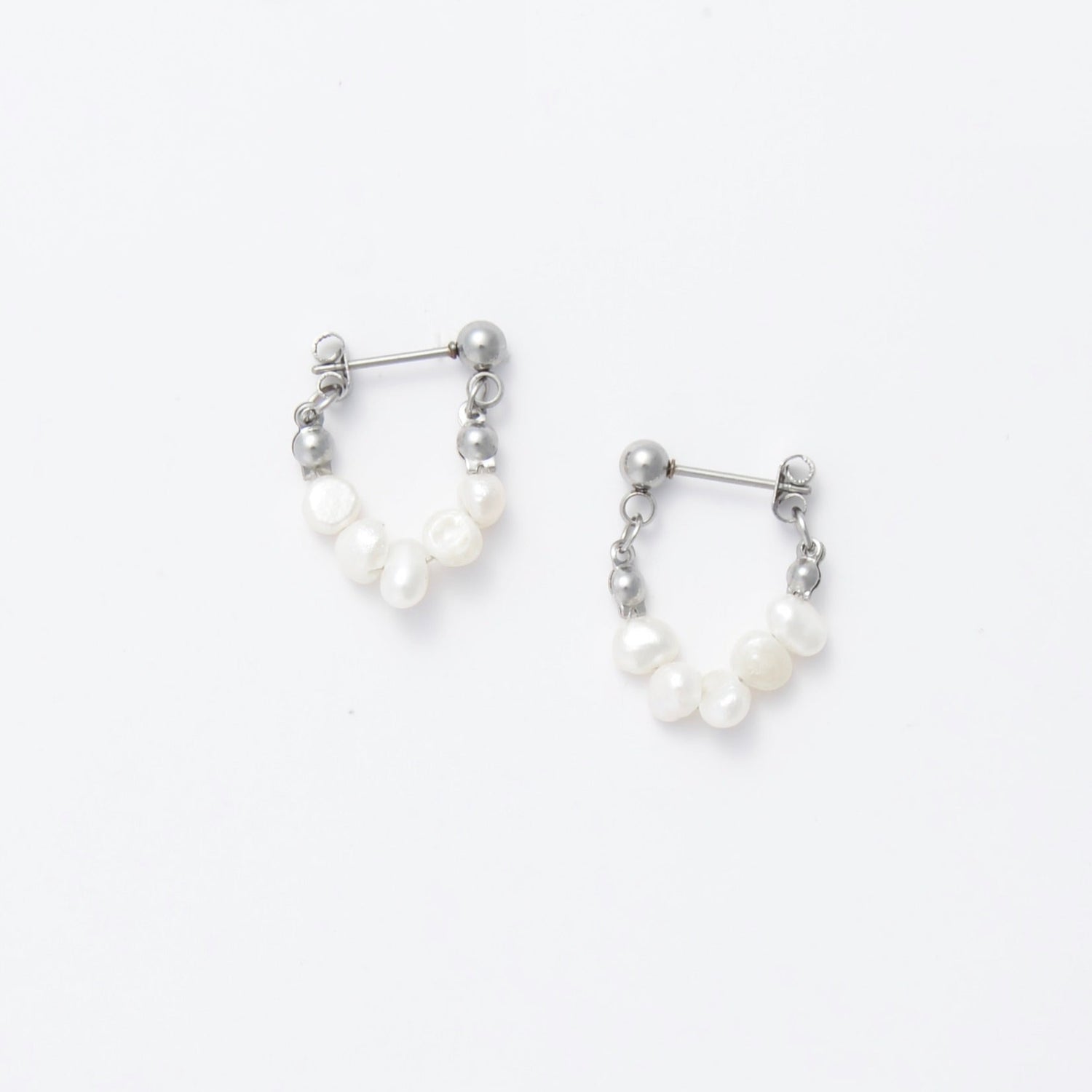
The pieces in the rings collection that sit closest to the finger are the ones that survive years of daily wear without note. The small hoops in the earrings collection are the ones that pass through scarves and coat collars without registering. And the chains in the necklaces collection that are built for layering tend to be the ones with the most consistent link weight, which is the architectural feature that prevents catches at the smaller links where a delicate chain typically fails.
The pieces that make a morning feel chosen
The pieces that make a morning feel chosen are the ones the wearer can put on without looking in a mirror. They sit in the same place every day. They do not require adjustment after they are on. They are not the first thing she thinks about when she gets dressed, but they are the last thing she touches before she leaves, which is a different kind of importance.
A ring she has worn for two years has become a small marker of the body. The skin underneath has remembered its shape. A chain that lives at the base of the throat has become the line where the morning ends and the workday begins. A pair of small hoops have become the punctuation that closes the sentence of getting dressed. None of these pieces were chosen for the moment they were first photographed in. They were chosen for the moment a hand goes up to the neck without looking and finds them where they always are.
This was the part of the morning that did not change during the three days of the strike. The trains were gone. The schedule was gone. The familiar rhythm of leaving the house at the same minute every weekday was gone. But the dish on the dresser was still there, and so were the pieces in it, and so was the hand that reached for them without thinking. A piece that requires attention every morning is a piece that gets left in the dish more often than it gets worn. A piece that does not require attention is a piece that becomes part of how the morning is built, even on the mornings when nothing else is.
For care across both materials, the jewelry care page is the longer reading. The short version is that stainless steel needs almost nothing and sterling silver needs a soft cloth and a quiet moment occasionally.
She steps off at Penn Station and turns east on 34th, walking against the slow tide of people coming the other way. The hand goes up to the neck without looking. The chain is where it always is, where it has been since the train pulled out of Hicksville at six. So is the ring, and so are the small hoops, and so is the version of her that has done this morning a thousand times, even during the week the trains were not running. The jewelry was not the point of the morning. It is the part that made the morning feel like hers, even on the days the train did not come.