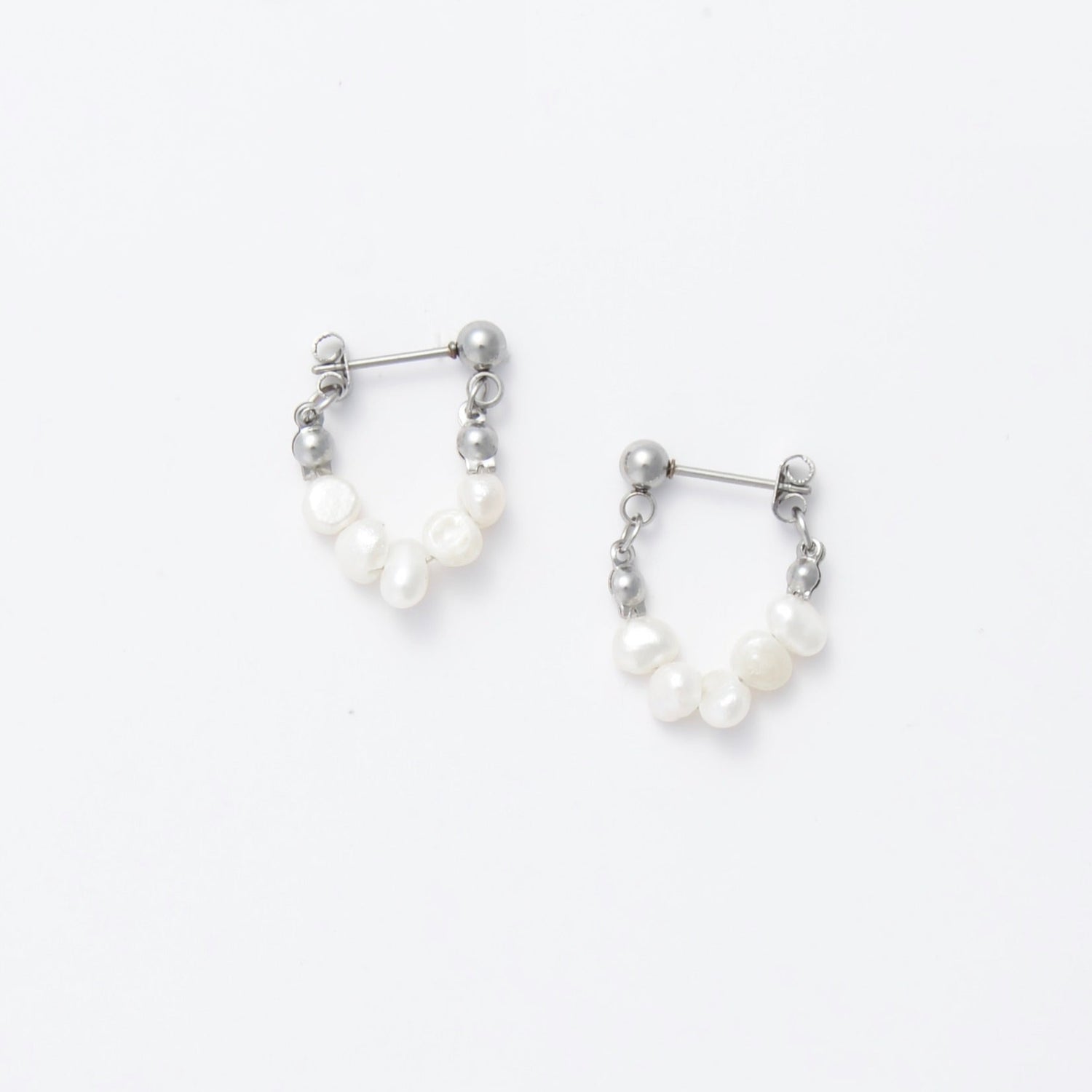
How a Glass Balloon Piece is Made: From Feeling to Form
Share
Most jewelry starts with a sketch. Mine starts with a feeling I can’t shake.
Not a trend forecast. Not a Pinterest rabbit hole. A specific mood that keeps returning like a song stuck in your head, or the way a hallway light hits your collarbone at 11:47 p.m. That’s usually where a Glass Balloon piece begins.
This post is a peek behind the curtain: how a piece moves from feeling to form, and what I’m actually thinking about at each step from materials to proportion to the tiny finishing decisions that make something feel intentional (not just “made”).
Step 1: Start with the emotional brief
Before I touch a chain or pick a pearl, I write a mini “feeling brief.” It’s simple, but it keeps the design honest.
I’m asking questions like:
- What moment does this belong to? Date-night touch-up in a restaurant bathroom. A quiet elevator ride. A Monday where you need a little armor.
- What should it do to the wearer’s posture or mood? Make you feel cleaner. Sharper. Softer. A little more composed. A little more daring.
- Is the energy calm or tense? Romantic or edged? Is this a whisper, or a statement that still looks effortless?
The output of this stage is usually:
- 3–5 keywords (ex: after-hours, restraint, orbit, softness, tension)
- one sentence that describes the piece like a scene
If the feeling isn’t clear yet, I don’t force it. The best designs happen when the emotional anchor is strong enough that the rest becomes editing—not searching.
Step 2: Translate feeling into a design language
Once the feeling is clear, I translate it into something visual and wearable. This is where Glass Balloon’s “vocabulary” comes in—materials and shapes that reliably express a mood.
Here are a few examples of how I think about it:
-
Freshwater pearls = softness, intimacy, glow
Pearls feel like candlelight. They make even a minimal look feel a little more alive. -
Chain = tension, edge, movement
Chain has attitude. It catches light differently. It sounds like something when it shifts. -
Asymmetry = human-ness, real life, a kind of charm
Perfect symmetry can feel formal. Slight imbalance feels like a personality. -
Negative space = restraint, quiet luxury, confidence
Not filling every gap is a choice. It’s what keeps the piece from feeling overdone.
I also think “silhouette first.” From three feet away, what does this read as?
- a clean collarbone line
- a sharp drop
- an orbit around the throat
- a tiny interruption that draws the eye
Then, up close, the details can reward you: a charm that feels like a secret, a pearl that isn’t perfectly round, a chain that has just enough weight to drape the way it should.
Step 3: Choose materials that tell the same story
Materials are not just a supply list. They’re part of the narrative.
Freshwater pearls: what I look for
Pearls can read “classic,” but in Glass Balloon they’re almost never about being traditional. I love freshwater pearls because they have character: subtle irregularities, personality, and an organic glow that doesn’t feel synthetic.
When I’m selecting pearls, I’m paying attention to:
- luster (the glow—does it look luminous, not flat?)
- shape (do I want clean and rounded, or slightly uneven and lived-in?)
- surface texture (a little texture can feel more intimate; too much can read rough)
- scale (a few millimeters changes everything emotionally—tiny feels delicate, larger feels bold)
Chain and metal: how it changes the vibe
Chain is one of the quickest ways to shift the entire mood. The same pearl can feel sweet or sharp depending on the chain’s weight and shine.
I think about:
- thickness / weight: does it drape or does it stand off the body?
- shine level: mirror-bright reads more modern; softer shine reads more vintage and intimate
- movement: does it sway fluidly or hold shape?
Accent stones and charms: why they belong
I use accents and non-certified gems when the design needs a note of color or symbolism—something that feels like a mood punctuation.
Charms are never there “just because.” I ask:
- does this charm add meaning?
- does it create tension (in a good way)?
- does it change the story of the piece?
If it’s only decorative, I usually remove it. The goal is intentional, not busy.
Step 4: Prototype the first version (and test it like it’s real life)
Version 1 is a draft. I’m not trying to make it perfect—I’m trying to discover what it wants to be.
What prototypes are really testing:
1) Proportion
- Is the charm too big for the mood?
- Does the pearl size read “soft” or “costume”?
- Is the spacing elegant or awkward?
2) Movement
Jewelry should move like it belongs on a body—because it does.
I test:
- how it sits when you turn your head
- how it behaves with hair down vs up
- how it looks when you walk (the “motion test”)
- whether it tangles or twists
3) Balance
Balance is the invisible difference between “handmade luxury” and “something feels off.”
I check:
- does the necklace pull to one side?
- does an asymmetrical drop intend to tilt, or is it accidentally unbalanced?
- does it settle naturally, or does it fight the body?
The mirror test
I always do a mirror test at different distances:
- close up (detail and texture)
- a few steps back (silhouette and vibe)
If it doesn’t read as the intended feeling from a few feet away, it’s not done—no matter how pretty the parts are.
Step 5: Refine until it feels inevitable
This is where the piece becomes “Glass Balloon.”
Refinement is mostly micro-decisions, but they’re everything:
- moving a charm 2–5 mm
- changing the chain weight slightly
- adjusting spacing between pearls
- removing one element that was trying too hard
There’s a specific kind of clarity I’m looking for: when the piece stops feeling assembled and starts feeling inevitable, like it couldn’t have been any other way.
The rule of restraint
One of my personal rules is:
one statement, everything else supports it.
If the hero is the pearl drop, the chain should frame it.
If the hero is the charm, the rest should quiet down.
If everything is yelling, nothing feels luxurious.
Step 6: Finish and quality-check (the “wear it and forget it” standard)
A piece can look good in a photo and still be wrong in real life. So finishing isn’t just aesthetic—it’s comfort, durability, and integrity.
I’m checking:
- secure connections: everything should feel stable, not fragile
- smooth contact points: nothing should scratch or snag
- clasp placement: practical and flattering
- wearability: does it sit well for a full day, not just 10 minutes?
The best compliment is when someone says:
“I wore it and forgot I was wearing it—until I caught myself in the mirror.”
That’s the goal: it becomes part of you.
Step 7: Naming is the final edit
Naming is not an afterthought. It’s the last decision that clarifies what the piece is.
I like names that are poetic but clear—a mood plus an object, or a feeling with a physical anchor.
A name should:
- sharpen the emotional brief
- hint at the story without overexplaining
- feel like the piece’s “true” identity
Sometimes a name even changes the final design—because it exposes what the piece is actually trying to say.
How to style a Glass Balloon piece (practical and real)
Because jewelry isn’t meant to live in a box. It’s meant to go out with you.
1) The clean uniform + one intentional statement
If your base is monochrome—black, charcoal, ivory, muted tones—one Glass Balloon piece can become the entire point of the look.
Try:
- black turtleneck + pearl drop necklace
- white tee + chain + a single charm
- slip dress + asymmetrical pearl detail
2) Layering without looking messy
Layering works when each layer has a job:
- one sits close to the neck (structure)
- one drops lower (movement)
- one small accent (punctuation)
If the layers compete, simplify. Edited always wins.
3) Day to night, without changing who you are
I love pieces that feel like they belong in both worlds:
- morning coffee, laptop open
- evening candlelight, lipstick in a compact
Same person, different lighting.
From feeling to form: why I make pieces this way
At the end of the day, I’m not trying to make jewelry that’s “perfect.” I’m trying to make jewelry that feels true—to a mood, a moment, a version of you.
A Glass Balloon piece is a small emotional object you can clasp onto your body.
A quiet ritual.
A little reminder that you can choose how you show up.
If you could turn a feeling into a piece—what feeling would you want it to hold for you? ✨